What makes a child bride and a dalit poor girl Maharastra become an icon and a Padmashri Awardee? Inspiring that any odds can always be made even!
Women of substance don't need an introduction. Their work speaks for
them. But what truly describes their achievements is their strength. The
strength to pull out of a hopeless darkness that threatens to consume
them whole.
Such
is the story of Kalpana Saroj, a self-made woman who didn't let the
ghosts of her past define her future. This is the story of a woman who
found light at the end of the blinding tunnel of abuse and torture.
Allow us to take you through Kalpana's life, a narrative that perfectly befits the title of 'Slumdog Millionaire'.
A child bride
Born in a dalit household
in Vidharbha, Kalpana got married at the age of 12 and settled in
Mumbai's slum area with her husband's family. However, after suffering
incessant physical abuse and mental torture by her in-laws, she left her
husband and was brought back home by her rescuer, her father.
A failed suicide attempt
Kalpana
tried to end her life following the ostracisation she faced from the
villagers. Thankfully, she failed and at the age of 16, she was back in
Mumbai - this time to live with her uncle's family.
A fresh start
Kalpana
soon started working in a garment factory to support her family
financially. With a heart that wanted to help the scheduled castes, she
took government loans with which she started her own tailoring business
and a furniture store.
A child bride
Born in a dalit household
in Vidharbha, Kalpana got married at the age of 12 and settled in
Mumbai's slum area with her husband's family. However, after suffering
incessant physical abuse and mental torture by her in-laws, she left her
husband and was brought back home by her rescuer, her father.
A failed suicide attempt
Kalpana
tried to end her life following the ostracisation she faced from the
villagers. Thankfully, she failed and at the age of 16, she was back in
Mumbai - this time to live with her uncle's family. outlookbusiness
A fresh start
Kalpana
soon started working in a garment factory to support her family
financially. With a heart that wanted to help the scheduled castes, she
took government loans with which she started her own tailoring business
and a furniture store. newsflicks
A movie production
Kalpana also ventured into film-making. She founded the KS Film Production and produced Khairalnji - a film that was dubbed in Hindi, English and Telegu.
An entrepreneurial venture
After
she had successfully established her real estate business, Kalpana
became a recognised name on the list of entrepreneurs. She served as a
board member in Kamani Tubes when the company went into liquidation in
2001. But as soon as she took over, profits started pouring in and the
company began moving towards the path of success.
A Padma Shri awardee
Her
contributions won Kalpana the Padma Shri honour in 2013. She was also
appointed as a board of director on Bhartiya Mahila Bank by the Indian
government.
Kalpana is one of the many examples who, by the sheer force of her
strength, is inspiring women everywhere. We salute her resolve and hope
she continues to shine like the brightest star in the sky!
With the sound of dewdrops,
Came my precious evening.
The sunset fringe of gold on the eagle's wing
Melts into the night
And the glow of fireflies.
Birds return to nest
The shop of life
Shuttered for the day.
Left behind in the darkness
Face to face
#AtoZChallenge: Inspiring Indian Women : J for Jyothi Reddy #Business Leaders
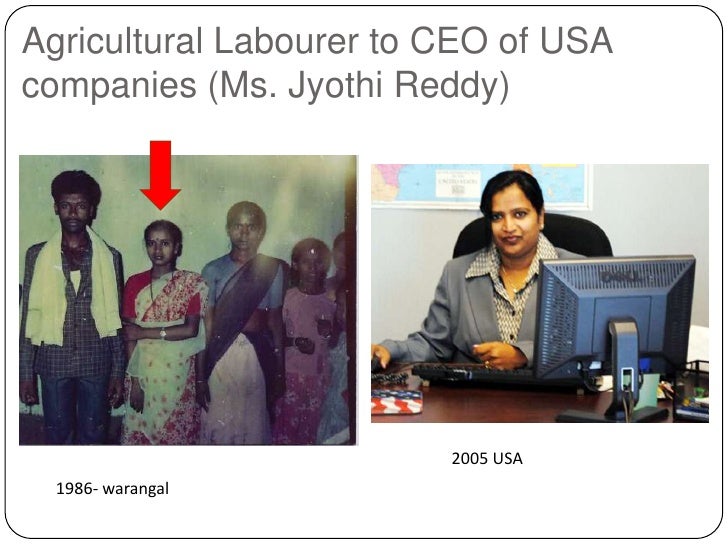
What makes the rags to riches story of Jyothi Reddy inspiring?
From a farm labourer to an IT millionairess, how Jyothi Reddy beat all odds to emerge a winner
That night she decided to break the rules. With a few friends, whom
she referred as akka, she did not return to the orphanage till way past
midnight.
It was Sivaratri, the great night of Shiva, when the planets are
potently aligned to embrace his cosmic dance. After visiting the Shiva
temple in their village, they decided to do something really daring — go
for a movie, a blockbuster love story. She laughs, a deep throaty
laugh, which betrays a teenager’s giggles at the memory of forbidden
pleasure.
Anila Jyothi Reddy has travelled very far from that night and her obscure village in Warangal in Telangana.
Her memories though are as fresh as it were yesterday. “When we
returned late in the night, we got a good thrashing from the warden. But
I was so enamoured by the movie that I did not much care for the
repercussion. I thought I should also marry for love,” she tells me.
Not all dreams come true
But fate — the eternal party spoiler – intervened. Jyothi was married
off exactly a year later at the age of 16 to a man 10 years her senior.
Love did not figure in the arrangement that her parents made for her
future. All her hopes of a better life seemed to recede like the
bullock cart in the rear-view mirror of a speeding highway truck. He was
a farmer who had not even passed the intermediate. She was thus doomed
to a fate of a daily farm labourer slogging the whole day in the paddy
field under the blazing hot Telangana sun. For all her efforts, Jyothi earned a meager Rs 5 a day. She did this for five years from 1985 to 1990.
“I became a mother at 17. I had to do all the household chores and
then head straight to the fields. I would return home at dusk and get
down to making dinner. We did not have any stove, so I had to cook on a
wood fire chulha,” she tells me over the phone from Hyderabad, where she
visits at this time of the year from her home in the US. Today, Jyothi is the CEO of a $15 million IT company, Key Software Solutions, based in Phoenix, Arizona, US.
Her incredible story seems to be the stuff of fiction conjured up by a
shrewd novelist inflicting numerous sufferings on his protagonist to
eventually make her a winner. Except here, Jyothi herself altered her
destiny. Unwilling to live a life that was preordained for her, she beat
all odds to emerge a winner.
A forced orphan
“I could not stand being poor. I was born poor and was wed into another poor family,”
she says. Those days her dream was to have four plastic boxes full of daal (lentils) and rice.
“I would dream of having more than enough food to feed my children. I
did not want to give them the life I was leading.” Having been married
off at the age of 16, Jyothi became a mother at 17 with her first
daughter, followed by another girl a year later. “At 18, I was a mother
to two girls. There was never enough money for either medicine or to buy
them toys.” When the time came to admit them in school, she opted for
Telugu medium because the fees was Rs 25 a month, while for an English
medium school it was Rs 50 per month. “I could educate both my girls at
Rs 50 hence I chose to send them to a Telugu medium school.”
Jyothi is the second among her four siblings. Because of abject poverty at home, her father admitted his two daughters into an orphanage saying that they were motherless.
“I lived in an orphanage for five years from class five to class 10.
Life there was tougher. My sister could not manage and would cry the
whole time. My father had to take her back home.”
But Jyothi stuck on. Even though she missed her mother and needed her
the most, she finally adjusted to remaining in the orphanage.
“I remember a wealthy man would visit the orphanage every year to
distribute sweets and blankets. I was a very sickly child then, and I
would imagine myself being rich one day and carry a suitcase with 10 new
saris in it,she laughs re-imagining her dreams those days, which she
was afraid to share with her hostel mates lest they made fun of her.”
Nobody’s children
Jyothi makes it a point to come to India every year on August 29. It
is her birthday and she celebrates it with children in different
orphanages in Warangal. She also sponsors a mentally challenged kids’
home where there are 220 children. She says passionately,
“Two percent of India’s population comprises orphans. They do not
have any identification. They are uncared for and unwanted. The people
who work in orphanages only work there for the money, and not to give
care and love to the orphans.”
She has been pursuing the cause of orphan children for many years
now and has met ministers in power to bring the plight of these children
to their notice. She is concerned that though the state government has
released data for orphan boys till class 10 who are in child remand
homes, there is no data for girl orphans. “Where are the girls? Why are they missing?” she asks and
replies to her own question. “Because they are trafficked; they are
forced into prostitution. I visited one home in Hyderabad where six
girls in their 10th class had given birth. In the same home, these mother orphans were living with their orphan children.”
Being in a position of power today, Jyothi is voicing her concerns at
every forum and making sure that the plight of the orphans does not go
unheard. But there was a time when she had to be a mute spectator to the
injustices meted out to her by her own husband and in-laws. With many
mouths to feed and little or no income, life was hard. “My concern was
my children. I had a lot of restrictions. I could not talk to any other
men, could not go out besides going to work in the fields.”
But as they say where there’s a will, there’s a way. Jyothi heard an
opportunity knock on her door when she started teaching the other farm
hands at a night school. From a labourer, she became a government teacher.
“I would motivate them to learn the basics. That was my job. I soon got
a promotion, and would visit every village in Warangal to train women
and youth to learn to stitch clothes.” She was now earning Rs 120 a
month. “It was as if I had got one lakh rupees. I could now spend on my
children’s medicine. It was a lot of money for me.”
The American dream
Jyothi’s aspirations were slowly growing wings. She completed a
vocational course from Ambedkar Open University and wanted to enroll for
MA in English at Kakatiya University in Warangal. “I had often dreamt
of having a name plate outside my house with the words ‘Dr Anila Jyothi
Reddy.’” However, she could not pass her course and all her dreams of
doing a PhD in English came to an end.
But a chance meeting with a cousin from the US fired her imagination
and she knew it in her heart that if she had to escape this vortex of
poverty she had to go to the US. “This is too much, right? This is crazy,” she laughs again with joy in reply to my question on how she managed to go to the US.
Talking about her NRI cousin who inspired her, she says,
“She had style. It was so different from my ‘teacher look’. I did not
leave my hair loose, I did not wear goggles or drive a car. I asked her
can I come to America.”
Her cousin told her, “An aggressive woman like you can easily manage in America.”
Jyothi did not waste any time and enrolled for computer software
classes. She would commute to Hyderabad daily because her husband did
not like the idea of her living away from home. She was determined to go
to the US. But it was hard to convince her husband. “I was really
greedy to go to the US. That was the only way I thought I could give my
children a good life.”
She took the help of relatives and friends to apply for a US visa.
“I make use of every resource and time that I can manage. I never
wasted time even while teaching. I used to run a chit fund for the other
teachers. My salary in 1994-95 was Rs 5000, I used to earn Rs 25,000
from the chit fund — all this when I was only 23-24 years old. I tried
to save as much as I could so that I could go to the US.”
Jyothi’s biggest desire was to drive a car, and she knew only if she
went to the US, she could drive one. “There were too many restrictions
at home. But one good thing my husband has done is given me two children
to fight my life,” she says with a chuckle. “My girls are like me. They
are hard workers and do not waste time.” Her daughters are software
engineers. They are both married now and live in the US. From poverty to abundance
The American dream is not an easy one. Though Jyothi fought her fate
and reached the land of opportunities, it was a rough ride. “There was
no support for me there. I did not know English very well, and it was a
struggle each day.”
She found a PG accommodation with a Gujarati family in New Jersey at
$350 per month. “I did not have a cell phone. I used to walk three
miles daily to work.” She worked as a sales girl, then as a room service
person in a motel in South Carolina, as a baby sitter in Phoenix,
Arizona, as a gas station attendant, and software recruiter in Virginia.
Finally, she started her own business.
“When I returned to my village after two years, I went to the village
temple for Shiv puja and the priest told me, ‘you will not get a job in
the US, but if you do business you will become a millionaire.’ I
laughed at him because I knew how hard it was in America.”
But those were prophetic words indeed. She finally took her daughters and her husband with her to the US.
According to her, the late President Abdul Kalam was her mentor, and
he would tell her that between the ages of 11 and 16 years, a child
builds character. “I was in the orphanage in those years of my life.
Even then I would help other children, and take care of those who cried
and bought them ice lollies.”
Jyothi recalls how she would walk bare feet even during the harsh
summer months. Curious, I ask her how many shoes she owns today? “I now
have 200 pairs. It takes me 10 to 15 minutes to find a matching pair
with my clothes.” And why shouldn’t she indulge. The first time she
bought herself anything was when she was working as a teacher. “I had
only two saris. I badly needed a third one. I bought a sari for myself
for Rs 135 and believe it or not, I still have that sari.” I had to ask
her which is the most expensive sari in her wardrobe? “I spent Rs 1
lakh, 60,000 on a blue and silver sari for my younger daughter’s
wedding,” she tells me with a nervous laugh.
She owns six houses in the US and two in India. And yes, she finally
made her dream of driving a car come true. She drives a Mercedes-Benz,
sports dark glasses and keeps her hair loose.
Drive to succeed
Such has been her journey that Kakatiya University’s second degree English lesson has a chapter on her.
“Believe me, once I had begged the same university to give me a job
and they had refused. Today, a lot of village children read about me and
want to know who this living person is.”
She has been speaking to me for more than an hour while she is on her
way to a meeting in Hyderabad. She is going to Delhi the next day to
take her case about missing orphan girls to the ruling party.
Life for her is no longer looking into the rear view mirror and
following rules made by other people. She is stepping up the accelerator
at full speed ahead.
You can reach Jyothi here.
It
seems when North Madras was reeling under a severe flood in theearly 40s causing extensive damage to the
properties in the area, the compound wall of one site was standing firm. When
S.Ananatharamakrishnan the legendary founder of the Amalgamations group decided
to find out the name of the engineer who built it, he discovered CRN whom he
promptly appointed as the designer of his next factory. That was the beginning
of an engineer, establishing a firm of architecture and construction in 1945 ,
which was to build a big reputation in the years to come.
Today
`CRN` is a well known name in the world
of Architectural designs and Construction management. Headquartered in Chennai
this 72year old firm has been serving clients not only within the country but also
across the globe. The list of their clients include the `who`s who` of the
industry.
The
credit for laying the foundation for thisvery successful venture must surely go to the visionary founder of the
company C.R.Narayana Rao.Born in a
middle class familyin Coimbatore, CRN graduated from College of Engineering,
Guindyas a Civil Engineer in 1935. His
first job was with the PWD. Later he joined a Britishfirm Jackson & Barker where he built his
reputation as anEngineer with keen
eyes forarchitectural detailing.
Starting
with just 20 employees,today the
company has a staff of over 400 qualified professionals from diverse
fieldsrelated to the construction
industry- architects, structural engineers, mechanical engineers etc. In addition to the Chennai office it has
branches in Bangalore & Hyderabad.
What
is the secret of the phenomenal success
of Narayana Rao, who was just an `Engineer`, the term by whichhe was popular in his company, who could
build a firm of such repute? It was his ` Social & People skills` say his
family members. In a field dominated by his peers in the industry who believed
in aggression in dealing with their work force and their working style, Narayan
Rao was well known for his self effacing humility. This did not stop this
`Engineer` from demanding the highest technical competence from his staff,never to suffer a poorly drafted drawings or
substandardexecution of projects.
The
first three decades of the firm`s existence coincided with the
industrialization of India. With its expertise in industrial architecture the
company was associated with prestigious companies of the time like Dunlop,
Amalgamations Group, TI group, Ashok Leyland, Ennore Foundries and the Rane
Group. Specialising in Prefabricated roofs, the company considers the unique
roofing structure it designedfor Ennore
Foundries as one of its pioneering efforts. In the early 70s the company added
the TVS group, Madras Fertilizers , MRF and a few educational institutions thus
expanding its design and project expertise.
It was around this time that the company
decided to extend to theMiddle East.
CRN`s overseas branch, acquiring a new name ` C.R.Narayan Rao ( Consultants)
Private Limited `, to satisfy the local legal requirements, successfully
executed several commercial, industrial and housing projects in Dubai, Abu
Dhabi and Ras Al Khamiah. This first ever overseas operation by any Indian
Architecture firm was dismantledafter
10 years to cope with exploding opportunities in India resulting in the company adding to its portfolio,prestigious corporate offices, Hospitals,
Shopping malls and educational institutions. Since the demise of Narayana Rao in 1982 the two
highly qualified sons of Narayana Rao-
Dr. C.N.Srinivasan ( a Phd in Engineering ) and C.N. Raghavendran not only ensured that the legacy of their
father was preserved but adapting to the changing needs of the time have taken
the company to greaterheights.
They
started acquiring business from the Government, both local and Central. They
also made their presence felt in the Sports facilities sector having
designedsix sports stadiumsof international standards not only in India
but also abroad. The Cricket Stadium they built in Guyana, in West Indiesis as much a testimony for their expertise in
the field as the Nehru Stadium in Chennai and the Foot Ball Stadium in Cochin.
The
nineties also witnessed the opening of the economyand explosion of information technology.CRN
was the firm privilegedto build the
first `Tidel park` in the country in Chennai. Both Srinivasan and Ragavendran are champions of Green buildings resulting in
their building huge complexes for almost all leading IT companies like TCS,
Infosys, Wipro in many parts of the country-all projects acquired by them against stiffcompetition from International Architectural
firms.
When
the prospect of the big automobile companies entering India became imminent the
Company made a blind pitch for the business from `Ford` in USA.Not only did they win the pitch, the
successful implementation of the Ford factory project in Chennai led to the
company being invited by other leading multinational automobile firms like
Hyunadi, BMW, Toyota, General Motors and Renaultto build their factories.
Nineties
also saw the entry of the third generation of the family in the business. It looks like the six members
belonging to the third generation of the family are working in total harmony
under the benevolent leadershipof the
Septuagenarian sons of the founder. I understand the fourth generation is
already knocking on the doors.
The Founder Mr.Narayana Rao was a highly
religious person.As a Madhwa Brahmin he
wasactively involved with Madhwa Mutts
and had won recognition for the services he rendered to the Community.His sons, however, believed in concentrating on Industry
bodies like BSI, CII, Green Building Congress etc. The third generationis active in working with civic authorities
on issues of urban interest.
Among
the Awards that the company has won is the `Intelligent building of the year2005`
award given by `Intelligent Community Forum` - a U.S.based researchorganization for their project `Ebene Cyber
Tower` at Mauritius which was inaugurated by Dr.Manmohan Singh, the then Prime
Minister of the country. Nehru Stadiumwhich was the first column free stadium built in the city,got the prestigious Indian Institute of
Architects Award for `Excellence in design`for Public building category for Raghavendran in 1995.The Cochin stadium got him recognizedas the `Architect of the Year` on an all
India basis in 1996. Raghavendran was
also conferred the `Padma Shri` award by the President of India in January
,2011.
A
company with excellent credentials and a good succession plan like `CRN` is
sure to witness its Platinum and Centenary celebrations in the years to come!
An
editedversion of this article appeared
in the May,2017 issue of Industrial Economist
What makes Ispita Dasgupta inspiring? Is it her role as President, Strategy and Incubation at Star India or her prior COO Experience at GE
It is not just her Harvard degree or extensive work experience or the making of best of both worlds being a mother and a wonderful woman, what makes this super woman more inspiring is her strength to manage all her worlds together and make it successful life.
An avid reader, Dasgupta used to read 45-50 books a year. But after
motherhood, things have changed. Dasgupta says it is the three women (or
girls) in her life that drive her - her mother and daughters. "My
daughters inspire me. Even knowing their importance, there are days I'm a
better business leader than a mother and the conflict is real. But I
keep my resolve because I have daughters - they should believe they can
be anyone they want to and that the privilege of motherhood should not
hinder that in any way."
Born in India, she travelled the world growing up and earned her
first degree, a double major in maths and economics, at Columbia
University. In her early 20s, she completed the MBA at Harvard Business
School and rose to senior strategy roles at IBM and then Cisco Systems,
before joining GE in 2011. As CCO, Ipsita takes the lead on marketing and strategy across India,
Bangladesh and Sri Lanka. She is responsible for analysing GE’s market
share in different sectors, and the changing needs of clients, and for
identifying which businesses to focus on for growth. She is also
responsible for the Bangladesh revenues and the largest key accounts in
the region.
Reflecting on her own MBA experience at Harvard Business School, Ipsita
says that the most valuable skill she learned was the ability to
develop a credible and informed point of view on any project or idea.
“In a big company people sometimes go through the motions without developing a point of view.”
At business school other students push you and you learn to maintain
your poise and to push back, and to change your position in light of new
information.
“Business school graduates can handle very stressful situations,” said Ipsita, “And come to incredible outcomes.”